
Jersey or interlock? The difference, explained at the counter
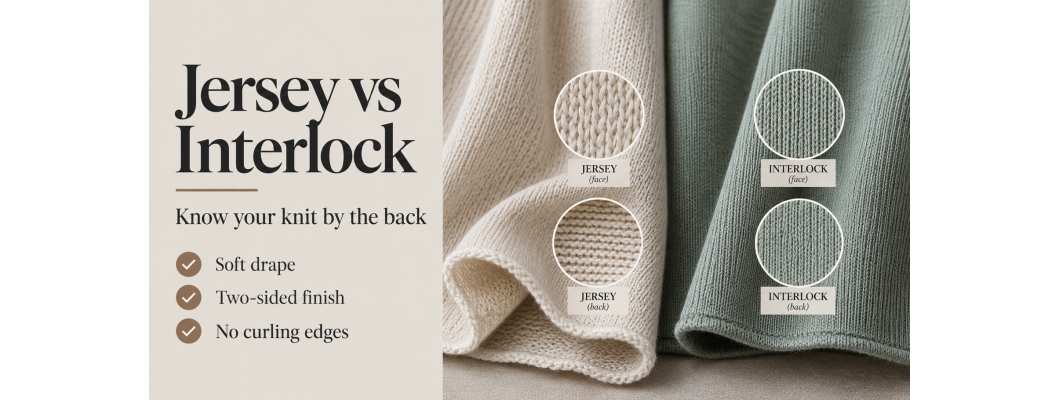
Last Saturday a customer laid a shop-bought T-shirt on our cutting table, turned inside out, and asked us to find her the same thing by the metre. Smart move, because the back of a knit tells you almost everything. The difference between jersey and interlock was exactly what she had been guessing at for two projects in a row: her first tee came out lovely and drapey, her second one felt like a sack. Same pattern, different knit. She had been sewing with jersey fabric cotton one time and a heavier interlock the next, without knowing it.
The questions we get at the counter
So what is actually different about the knit itself?
Turn both fabrics over. Jersey is a single knit: made on one set of needles, so you get neat little V shapes on the front and rows of horizontal loops on the back. The columns of stitches are the needle rows, the horizontal lines are the course rows, and that structure is why jersey has so much give sideways.
Cotton interlock knit fabric is knitted on two sets of needles at once. You basically get two fine jersey layers locked into each other, face out on both sides. That is why you can stare at a piece of interlock for a minute and still not know which side you are looking at. Hold it up to the window: interlock is denser and lets less light through than a jersey of similar weight.
Why does my jersey roll up at the edges and my interlock doesn't?
Blame the single knit. Because the loops all sit on one side, a cut edge wants to curl towards the front along the columns and towards the back along the rows. It is not a fault, it is the structure doing what it always does. Interlock has that pull balanced out by its second layer, so a cut edge just lies there, flat and well behaved.
For jersey it helps to cut with the fabric fully supported on the table instead of hanging over the edge, and to pin or clip right before you sew rather than an hour beforehand. Necklines are where curling drives people mad, and honestly the quickest fix is jersey bias binding 20mm. It stretches with the fabric and gives the edge something to hold onto.
Which one do I want for a T-shirt, and which for baby clothes?
For a soft summer tee, a wrap top or anything that should fall close to the body, jersey. It is lighter, it drapes, and it moves with you. For baby rompers, toddler leggings, little dresses and sweat-style tops, interlock. It has more body, it holds a shape after washing, and it does not go transparent over a baby's bum. Plenty of our customers who sew for kids buy nothing else.
A lot of the loveliest prints for children sit on the lighter knits, so many people combine: an interlock body with a jersey lining, or a jersey top with organic cotton jersey fabrics for the parts that touch the skin.
Do I sew them differently on my machine?
Same needle type for both: a ballpoint or jersey needle, which pushes the loops aside instead of piercing them. Use a narrow zigzag or your machine's stretch stitch so the seam can move. Interlock is the friendlier of the two under the presser foot, because it is stable and feeds evenly. Jersey is the one that goes wavy if you push or pull it through, so let the machine take it and keep your hands flat beside the fabric.
Always run a test on a leftover strip first. Sew about ten centimetres, stretch the seam with both hands, and see if the stitches pop. That tells you more in twenty seconds than any setting chart.
And all those other knits you sell, where do they fit in?
Most of them are variations on these two ideas. Rib knit jersey fabric is the stretchy ribbed one you use for cuffs, waistbands and neckbands, and it springs back beautifully. Punta di milano jersey fabric is a firmer double knit with a smooth surface, the kind of thing you want for a blazer, a straight skirt or trousers that need to keep their line.
What we usually send people home with
Buy a small piece of both before you cut into your good fabric. Wash it the way you will wash the finished garment, press it with your normal iron on a medium setting, and then decide. Knits relax and shift a little after that first wash, and you would rather find out on a test piece than on a finished dress. And mark the right side of your interlock with a chalk cross or a bit of masking tape the moment you cut, because two hours later you will not be able to tell. Our full range of jersey fabrics sits together in one place, so you can compare weights side by side.
Frequently asked questions
Can I use interlock for a neckband or cuffs?
You can, on a loose-fitting top, but it does not spring back the way a rib does. For a neckline that has to stretch over a head and then sit flat again, a rib knit or jersey bias binding gives a much better result.
Which side of interlock is the right side?
Both sides are knitted face out, so visually there is often no wrong side at all. On printed or brushed interlock the difference is obvious. On plain colours, pick one side, mark it, and use the same side for every piece so the surface catches the light evenly.
Does interlock shrink more than jersey?
Cotton knits generally relax in the first wash, and a denser knit can pull in a bit more lengthwise. Wash and dry a test square the way you plan to treat the garment, then measure it before you cut.