
Ordering Fabric for Your School, Care Home or Business: How Invoice Payment Works
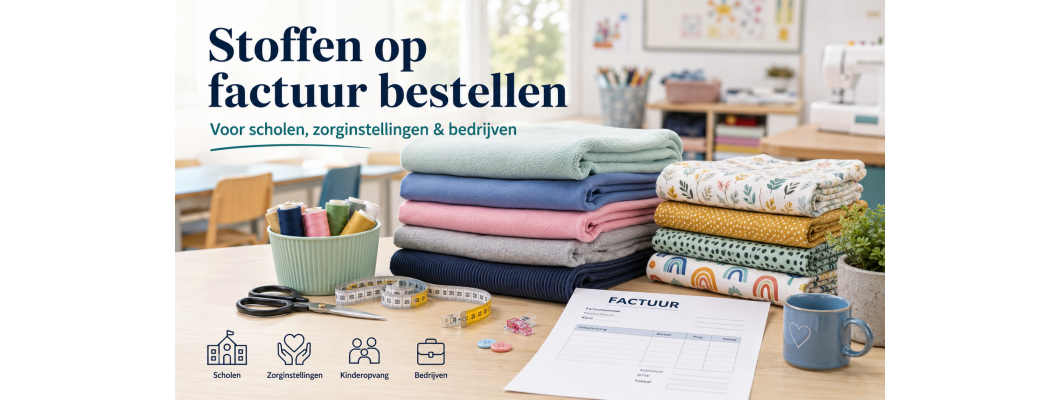
Picture forty metres of deco fabric rolled out across two long tables in a care home's activity room, ready to be cut into curtains for twelve resident rooms. That's the project a facilities coordinator at a care home brought to us last spring, and it's a good example to walk through because ordering fabric for an institution works differently than ordering a metre of jersey for a t-shirt. No personal credit card, no waiting by the letterbox for a package you paid for out of pocket. Just a proper invoice payment arrangement between the institution and us, sorted before the fabric even leaves the warehouse. We picked a sturdy deco fabric for this one, and I'll talk you through why, how much we ordered, and how the whole invoice process actually ran.
If you're a school ordering fabric for a textiles class, a healthcare institution needing curtains or bedding, or a small business stocking up for production, this same process applies to you. Let me show you exactly how it went.
The fabric choice: deco fabric that survives daily use
Care home curtains get a rough life. They're opened and closed by hand multiple times a day, sometimes yanked rather than pulled, and they need to look good under fluorescent lighting for years, not months. We steered the coordinator away from lightweight cottons and toward a woven deco fabric with a tighter weave, the pattern of how the threads cross over and under each other, which gives it more body and resistance to sagging over time.
Colour mattered too. The coordinator wanted something calm but not clinical, so we looked at a soft ochre with a subtle woven texture rather than a printed pattern, since prints on cheaper deco fabric can fade unevenly near windows that get direct sun. If your project leans more toward clothing production instead of interiors, the same reasoning applies when browsing fashion fabrics or linen fabrics for institutional use. Schools ordering for craft classes often mix in knitting and crochet yarn alongside woven fabric, and that combined order can go through the exact same invoice process described below.
Preparation: measuring the rooms before cutting a single metre
Before we cut anything, the coordinator sent us the window measurements for all twelve rooms. Some varied by a few centimetres, so we calculated total metres needed with extra allowed for hems and pattern matching, then rounded up. For a job this size you always want a bit of buffer fabric, because if you run short by half a metre on the last window, you're stuck waiting on a second delivery.
Deco fabric like this doesn't need pre-washing the way jersey does, since curtains aren't laundered often and shrinkage isn't the issue it is with a garment. We did recommend steaming the fabric lightly before cutting, just to relax any fold lines from being rolled on the bolt.
Processing: sewing curtains that hang straight
Standard sewing machine, a fresh needle sized for medium weight woven fabric, and a straight stitch did the whole job. No overlocker required, though one makes the raw edges tidier if you have access to one.
A few things to watch on a job like this:
- Cut every panel with the grain, the direction the threads run, or the curtains will hang slightly twisted once they're up.
- Press seams open as you go rather than at the end, it's much easier on fabric this size.
- Weight the bottom hem with a double fold rather than a single one, so the curtain drapes with enough weight to hang flat against the window.
Finishing and care
Once hemmed, we pressed each panel with a warm iron and hung them the same day so any minor creasing worked itself out under gravity. For ongoing care, the coordinator's team was told to vacuum the curtains occasionally with a soft brush attachment and only wash them if truly necessary, since repeated washing of woven deco fabric can dull the texture over time. A gentle spot clean handles most marks just fine.
Other projects, same invoice process
The same care home later ordered fleece fabrics for lap blankets in the same way, and a nearby school placed a separate order for jersey fabrics for a home economics project. Both went through invoice payment without a hitch. If your institution wants to try this: place your order on our website as usual, choose bank transfer as the payment method, and write in the order comments that it concerns an invoice in advance. We'll adjust the order on our end and send the invoice by email. Once payment is received, we ship the products straight away. If you're working with a tighter budget, it's worth checking the fabric outlet or cheap fabrics section before finalising quantities, since institutional orders often run large enough that a lower price per metre makes a real difference on the total invoice.
FAQ
Can any type of institution order on invoice?
Yes, we set this up for schools, healthcare institutions, businesses and other organisations. Place your order as normal, select bank transfer, and mention in the comments that you want an invoice sent in advance.
When do you ship the fabric after an invoice order?
We ship as soon as we've received payment for the invoice. There's no separate approval step beyond that, so the sooner the transfer clears, the sooner your fabric goes out.
Can I combine different fabric types in one invoice order?
Yes, you can mix deco fabric, jersey, fleece or even knitting yarn in a single order. We'll adjust the order and invoice based on everything in your cart, so there's no need to place separate orders per fabric type.