
Natural vs Synthetic Fibres: What Actually Happens When You Sew Them
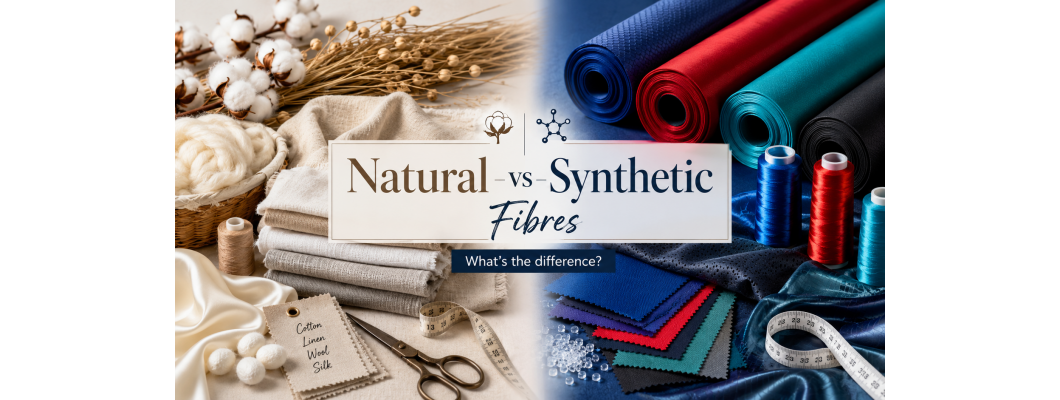
Here's something that surprised me the first time I heard it: nylon was invented by a chemist trying to make an artificial silk cheap enough to replace it in stockings, and it hit the market in 1939 with a marketing campaign so successful that women queued around city blocks to buy their first pair. Cotton, on the other hand, has been spun by hand for over 7000 years, long before anyone had a word for polymer. That gap, between something grown from a plant and something built in a lab from petroleum, is the whole story of natural versus synthetic fibres, and it matters every single time you pick up a piece of fabric for a new project. If you've ever wondered why one fashion fabric drapes like water while another springs back into shape, the answer is almost always fibre content.
I get asked about this constantly at the shop. Someone holds up two fabrics that look nearly identical and asks why one costs more, feels different against the skin, or irons flat while the other just won't cooperate. So let's actually break down what's going on, from where these fibres come from to how they behave under your needle.
Where these fibres actually come from
Natural fibres come from plants or animals. Cotton is a seed hair, it grows as a fluffy boll around cotton seeds and gets picked, cleaned, and spun into yarn. Linen comes from the stalk of the flax plant, the fibres sit inside the stem and have to be separated out through a process called retting, basically rotting away the woody bits until only the fibre remains. Wool is sheared from sheep, silk is unwound from the cocoon of a silkworm. All of it starts as something living.
Synthetic fibres start in a completely different place: a chemical plant. Polyester, nylon, and acrylic are made from petroleum-based polymers that get melted and forced through a device called a spinneret, essentially a metal disc full of tiny holes, which extrudes the melted polymer into long continuous filaments. Those filaments cool, solidify, and get wound onto spools ready for weaving or knitting. There's also a middle category worth knowing: viscose and rayon are technically man-made, but they start from wood pulp, so they're not synthetic in the petroleum sense, they're regenerated cellulose. That's why viscose feels closer to cotton on your skin than to polyester.
How they actually behave once you're sewing them
This is where it gets practical. Natural fibres like cotton and linen breathe well because the fibre structure lets air move through and absorbs moisture rather than trapping it against your skin. That's why a linen shirt feels cool in summer. But natural fibres also wrinkle more, since the fibre itself doesn't have much memory, it holds whatever shape you press it into, wrinkles included.
Synthetic fibres behave almost the opposite way. Polyester and nylon resist wrinkling because the filament has a kind of elastic memory, it wants to bounce back to its original shape. That's also why synthetics often feel less breathable, the fibre itself doesn't absorb moisture the way cotton does, it just lets it sit on the surface. On your machine, this translates into real differences: synthetic wovens tend to fray less at a cut edge because the filament doesn't shred the way a natural fibre does, but they can also be slippery under the presser foot, so pin generously and consider a walking foot if yours has one.
Stretch knits complicate this picture further. A lot of the jersey fabrics people love for t-shirts and dresses actually blend natural and synthetic fibres on purpose, cotton for breathability, a touch of elastane for recovery. That's not a compromise, it's engineering the best of both.
What we carry, and why the mix matters
In our own range you'll find this natural-synthetic spectrum play out across every category. Our cotton jersey fabric is a good example of natural fibre knit comfort, soft against the skin, breathable, great for everyday tees. Step over to scuba crepe jersey fabric and you're in synthetic territory, a heavier, structured knit with real body that holds a silhouette in a way pure cotton never could. Our viscose jersey fabric sits in that in-between space I mentioned, wood-based, drapey, with a fluid fall that natural cotton doesn't quite achieve on its own.
For colder projects, polar fleece fabric is entirely synthetic, spun from polyester, and it's exactly that synthetic structure that gives it insulating warmth without much weight. If you want something with more natural texture and weight for structured garments or home projects, our linen fabrics are worth a look, and if you're after decorative or upholstery-weight pieces where durability matters more than breathability, browse our deco fabrics, many of which lean synthetic for exactly that reason.
So which one should you actually reach for
If you're making something worn close to the body in warm weather, a summer top, underwear, loungewear, go natural. Cotton and linen breathe, and that matters more than wrinkle resistance for comfort. If you're making activewear, swimwear, or anything that needs to hold shape and bounce back after stretching, synthetic fibres or a natural-synthetic blend will serve you far better; pure cotton alone has no memory and will bag out at the knees or elbows over time.
Budget also plays a role here, worth checking our fabric outlet if you're testing fibre types before committing to a bigger project, and our new fabrics page if you want to see what's just arrived across both categories. Grab a scrap of each, run it through your machine on a test seam, and feel the difference for yourself. That's really the only way to know which one your hands prefer.
FAQ
Is viscose a natural or synthetic fibre?
Neither, exactly. Viscose is made from wood pulp, so it's plant-based at the source, but it goes through a chemical process to turn that pulp into fibre, which is why it's classed as a regenerated or man-made cellulosic fibre rather than fully natural or fully synthetic.
Why does polyester feel less comfortable in hot weather than cotton?
Polyester filament doesn't absorb moisture the way cotton fibre does. Sweat sits on the surface of the fabric instead of being drawn away from your skin, so it feels warmer and clammier even if the fabric weight is similar.
Can I mix natural and synthetic fibres in the same garment?
Yes, and most stretch fabrics already do this. A cotton-elastane jersey gives you the breathability of cotton with the shape recovery of a synthetic fibre, which is exactly why it's such a common combination for t-shirts and dresses.
Does fibre type affect how I should iron a fabric?
Definitely. Natural fibres like cotton and linen tolerate higher iron heat, while synthetics such as polyester and nylon can melt or glaze under too much heat, so always test on a scrap first and use a lower setting for synthetic or blended fabrics.