
Twill Fabric: What It Is, How to Recognise It and What to Sew With It
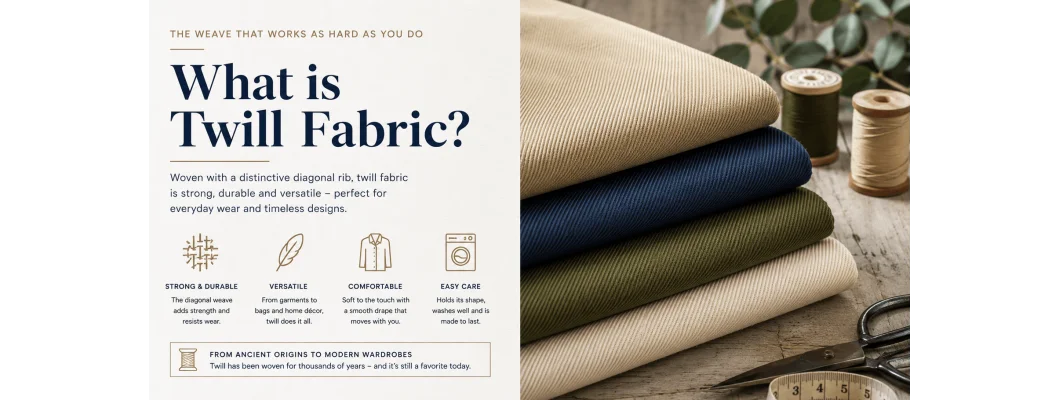
Back in the 19th century, sailors on cotton twill ships wore trousers made from a sturdy diagonal weave because plain cotton simply wore through too fast at the knees and seat. That same weave, the diagonal ribbing you can still run your finger along today, is exactly what gives twill its name and its reputation for lasting through years of wear. It comes from the French word "tirer", to pull, referring to how the weft thread pulls over and under the warp threads in a staggered pattern rather than a straight over-under.
Twill fabric is one of those materials you've probably touched a hundred times without knowing its name. It's in your trousers, your bag lining, your winter coat. Once you know what to look for, you'll spot it everywhere. In this guide I'll walk you through what twill actually is, how the weave works, where cotton twill fits into the family, and what it's good for on your own sewing table. If you're comparing it to knits like jersey fabrics, keep in mind twill behaves completely differently: it doesn't stretch and it doesn't curl at the cut edge.
What Is Twill and Why Does It Feel So Sturdy?
Twill is a weave structure, not a fibre. That's the first thing to get straight. You can weave twill from cotton, wool, silk or synthetic yarns. What makes it twill is the way the threads cross: instead of a simple over-one-under-one plain weave, the weft thread goes over two or three warp threads before dipping under one, then shifts one step sideways on the next row. That shift is what creates the diagonal line, called the wale, running across the fabric surface.
Because of that structure, twill has fewer thread interlacings than plain weave. Fewer crossing points means the yarns can pack in tighter and move against each other more freely, which is exactly why twill drapes with a bit more body and resists wrinkling better than a flat plain weave cotton. It also tends to hide soil and stains better, which is part of why it became the fabric of choice for workwear.
The Different Twill Weave Patterns
2/1 Twill
This is the most common ratio you'll come across: the weft goes over two warp threads and under one. It gives a clear, medium diagonal line and is the base structure for chino fabric and many mid-weight cotton twills.
3/1 Twill
Here the weft floats over three warp threads before going under one. With more thread surface exposed on top, the fabric gets a slightly smoother face and a bolder, more pronounced diagonal. Denim is typically woven this way, though usually with coloured warp and white weft, which is what gives jeans that fade pattern when they wear.
Cotton Twill: The Everyday Workhorse
Cotton twill deserves its own spot in this guide because it's the version most of us actually sew with. In our assortment we carry 137 active cotton twill articles, and they range from 75 to 150 g/m2, averaging around 128 g/m2. That's a light to mid-weight range, nothing stiff or heavy like upholstery cloth. Most of what we stock is Light Weight, with a small portion classed as Ultra Light Weight for finer blouses.
The composition splits between 100% Cotton and 100% Mercerised Cotton, the latter having gone through a treatment that gives the yarn a subtle sheen and a slightly firmer hand. You'll see that reflected in the finish too: alongside plain Matte cotton twill, we have pieces with a Soft Silky Sheen or Soft Satin Sheen thanks to Mercerised, Sandwashed, Stonewashed or Silk finishing. All of it has No Stretch, so what you cut is what you get, no surprise give in the seams.
Now, here's where people often mix things up: cotton twill and denim are not the same fabric, even though both can use a twill weave. Denim is almost always a 3/1 or similar twill woven from a heavier, coarser cotton yarn, often with that classic indigo warp and undyed weft. Cotton twill in dressmaking is finer, more evenly dyed through, and woven at a lighter weight, closer to what you'd use for a shirt or a tailored skirt than for rugged trousers. Our cotton twill sits mostly at 135 cm or 150 cm width, with some rolls at 140 cm and 145 cm, and it's rated High for breathability across the board, which denim rarely matches.
Working With Twill: Practical Tips
- Use a Universal needle in size 70/10 to 80/12. Anything thicker will leave visible holes in the lighter weights.
- Because there's No Stretch, pin generously and don't pull the fabric while feeding it through your machine, it can shift off-grain otherwise.
- Wash at 30°C to protect the Mercerised or Silk finish, and check a scrap first if you're combining twill with a contrasting fabric that might bleed.
- The diagonal wale shows up more on some finishes than others. On a Sandwashed or Stonewashed piece it's more matte and subtle, on a Mercerised one it catches the light more, so keep pattern pieces cut in the same direction if you want an even look.
- For pressing, a normal household iron is fine, twill takes heat well thanks to its cotton fibre content, just avoid over-pressing the mercerised sheen flat.
Which Twill Should You Pick?
For a tailored blouse or a soft shirt, go for the lighter end, around 75 to 100 g/m2, with a Fluid Drape rather than Medium Drape, so it moves instead of standing stiff. For a structured skirt or a pair of trousers with a bit of shape, look at the Medium Drape pieces in the mid-range weight, they hold a pleat and a waistband better. If you want something with visual texture beyond the diagonal wale, the Double Gauze Weave versions in our range give a softer, slightly more textured hand than the standard Plain Weave twill base.
Twill also works nicely for home sewing projects: cushion covers, table runners, lighter curtains. If that's your plan, it's worth browsing our deco fabrics alongside the twill range for coordinating colourways.
In Short
Twill is defined by its diagonal weave, not by a single fibre, and cotton twill is the version most sewists reach for because it's breathable, holds its shape without stretch, and takes a mercerised or stonewashed finish beautifully. It's not denim, even if the two share a weave family. If you're building a wardrobe with pieces that need more drape or stretch alongside your twill projects, have a look at our fashion fabrics, and if you're after something warmer for the colder months, our fleece fabrics and linen fabrics are worth a browse too. And if you just want to try a swatch before committing to a full cut, check our fabric outlet for remnants at a lower cost.
FAQ
Is twill the same as denim?
No. Denim is woven using a twill structure, usually 3/1, but it's a specific heavier cotton fabric with a coloured warp thread and undyed weft. Cotton twill for dressmaking is lighter, more evenly coloured and drapes softer.
How do I recognise twill fabric by sight or touch?
Look for the diagonal ribbed line running across the surface, called the wale. Run your fingers across it at an angle and you'll feel a subtle ridge pattern rather than a flat, even surface like plain weave.
Does cotton twill stretch?
No, cotton twill in our range has No Stretch. Cut with the pattern grainline in mind and don't expect any give in the seams, unlike a jersey knit.
What can I sew with cotton twill?
It suits blouses, shirts, skirts and dresses well, and the heavier end works for home decoration projects like cushions or runners. Lighter weights with Fluid Drape are better for garments that need movement, while Medium Drape pieces hold structure for tailored items.