
Sewing cork fabric: what it is, how to work with it, plus a card holder and zip pouch (free pattern)
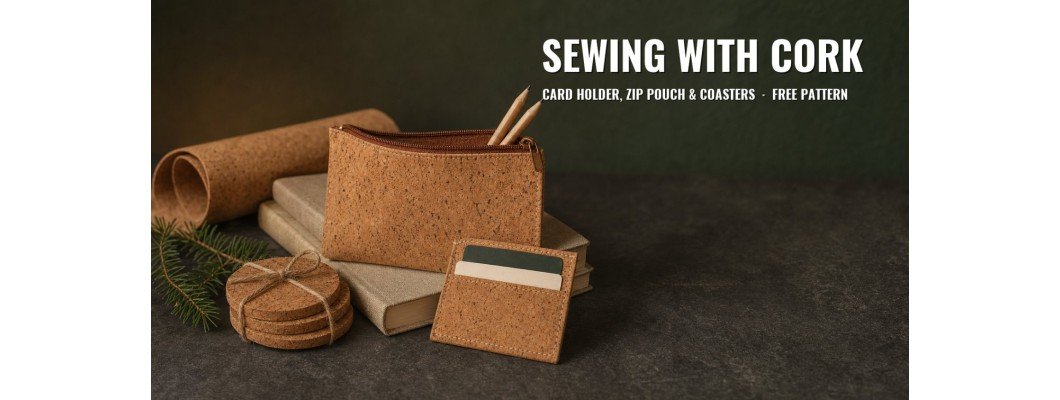
Cork fabric is a thin layer of real cork on a cotton backing. It feels like supple leather, doesn't fray and can be sewn on an ordinary sewing machine. You buy it by the metre, and because the edges need no finishing it is ideal for small, quick projects. In this blog you'll read what cork fabric is, how to sew cork without holes and crooked seams, and you'll make three gifts: a card holder, a zip pouch and coasters. The templates are printed at actual size in the free pattern.
Download the free cork pattern (PDF)
What is cork fabric?
Cork is the bark of the cork oak. The bark is stripped from the tree and then grows back; the tree is left standing. To make cork fabric, the cork is sliced into wafer-thin sheets and laminated onto a cotton cloth. The result is a material that looks like cork but bends and sews like a fabric.
The cork fabric by the metre from Rijs Textiles is made of 80% cork and 20% cotton. It is 140 cm wide, 0.7 mm thick, weighs 266 g/m² and has no stretch. The surface is matt and feels warm and slightly velvety. Every metre is a little different: the flecks and veins are never in the same place.
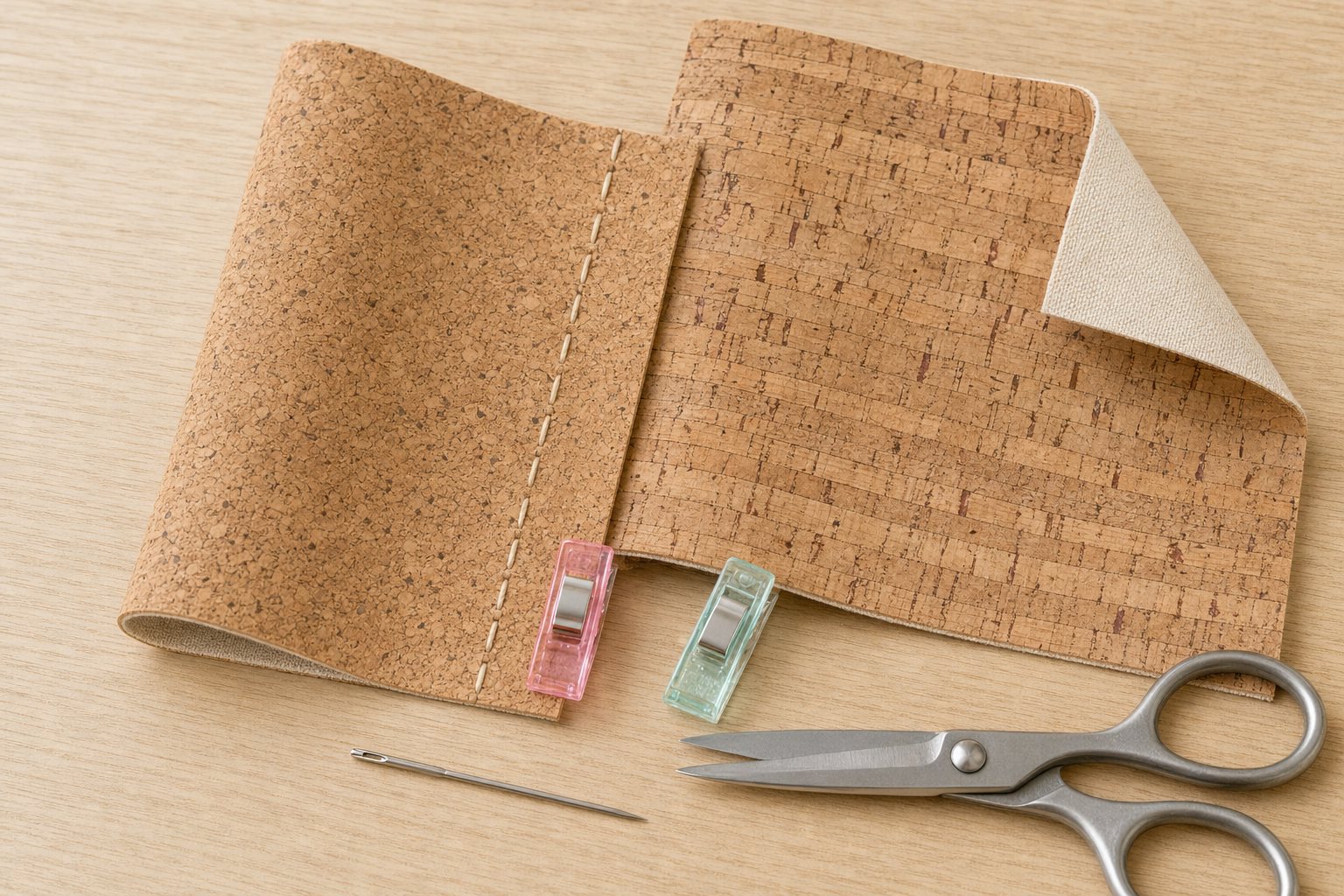
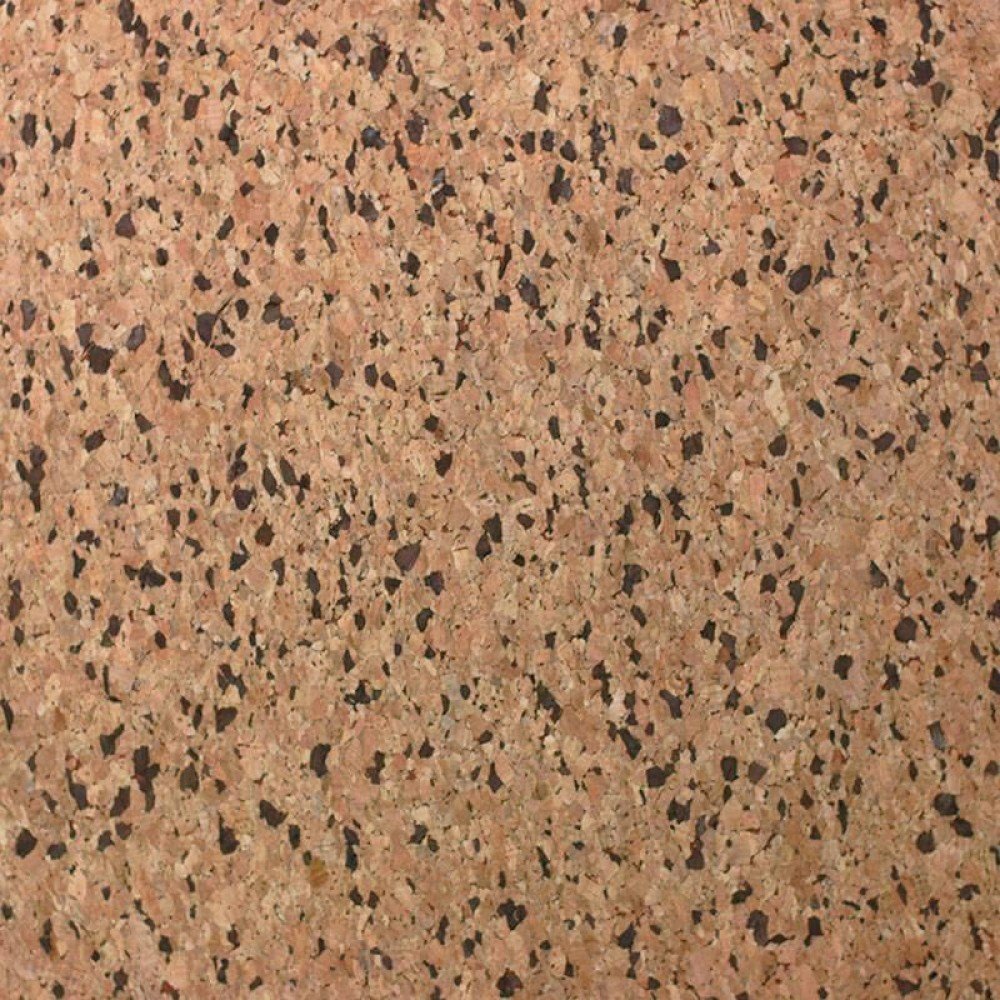
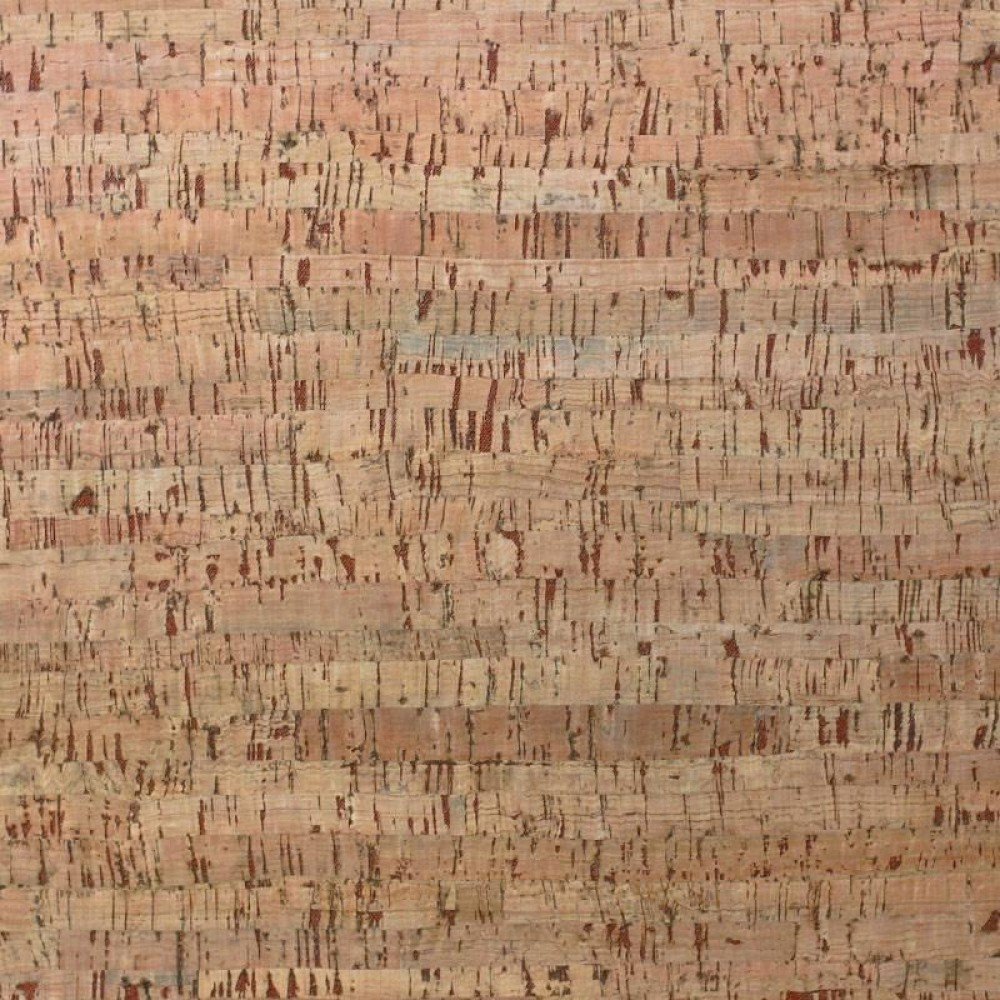
There are two designs, both in natural:
- Cork fabric per metre, raw quality: grainy, with dark flecks, like a pinboard but thin and supple.
- Cork fabric per metre, stripe quality: narrow bands with fine dark veins, the familiar look of cork bags and purses.
Both cost €29.95 per metre (incl. VAT). That sounds like a lot, but the projects below only need a small piece. If you'd like to see and feel the cork first, order a sample on the product page (€0.50 incl. VAT).
Properties of cork fabric
- Doesn't fray. You can leave an edge raw, just as with felt or leather. That saves you hems and lining.
- Water-repellent and wipe-clean. A stain wipes off with a damp cloth.
- Light. At 266 g/m², cork fabric weighs about half as much as 3 mm bag felt.
- Firm but supple. The fabric has body and holds its shape, yet you can turn and fold it.
- Plant-based. An alternative to leather with no animal-derived materials.
There are also things cork fabric can't do. It doesn't stretch, so it is unsuitable for close-fitting clothing. It must not go in the washing machine (hand wash only), in the tumble dryer or under the iron. And every needle hole stays visible: unpicking leaves marks.
Cork fabric, vegan leather or bag felt?
None of the three frays and all are suitable for bags and accessories. The difference lies in the look, the thickness and the price.
| Cork fabric | Vegan leather | Bag felt 3 mm | |
|---|---|---|---|
| Composition | 80% cork, 20% cotton | polyurethane on a polyester and elastane backing | 100% polyester |
| Weight | 266 g/m² | 240 g/m² | 580 g/m² |
| Width | 140 cm | 140 cm | 90 cm |
| Stretch | none | across the width | none |
| Look | matt, natural, every piece unique | even, soft sheen, suede-like | matt, woolly, thick |
| Price per metre | €29.95 (incl. VAT) | €11.95 (incl. VAT) | €9.95 (incl. VAT) |
Choose cork if you want a natural material that stands out and you are making small things. For a large bag or a jacket, vegan leather is better value; read more in our blog what is vegan leather. If you want a bag that stands up on its own, 3 mm bag felt is the easiest choice, for example for the felt bag with free pattern. You can also combine them: a cork base or flap on a bag made of canvas.
Sewing cork: seven tips
- No pins. Every hole is permanent. Use sewing clips, paper clips or a strip of tape outside the seam.
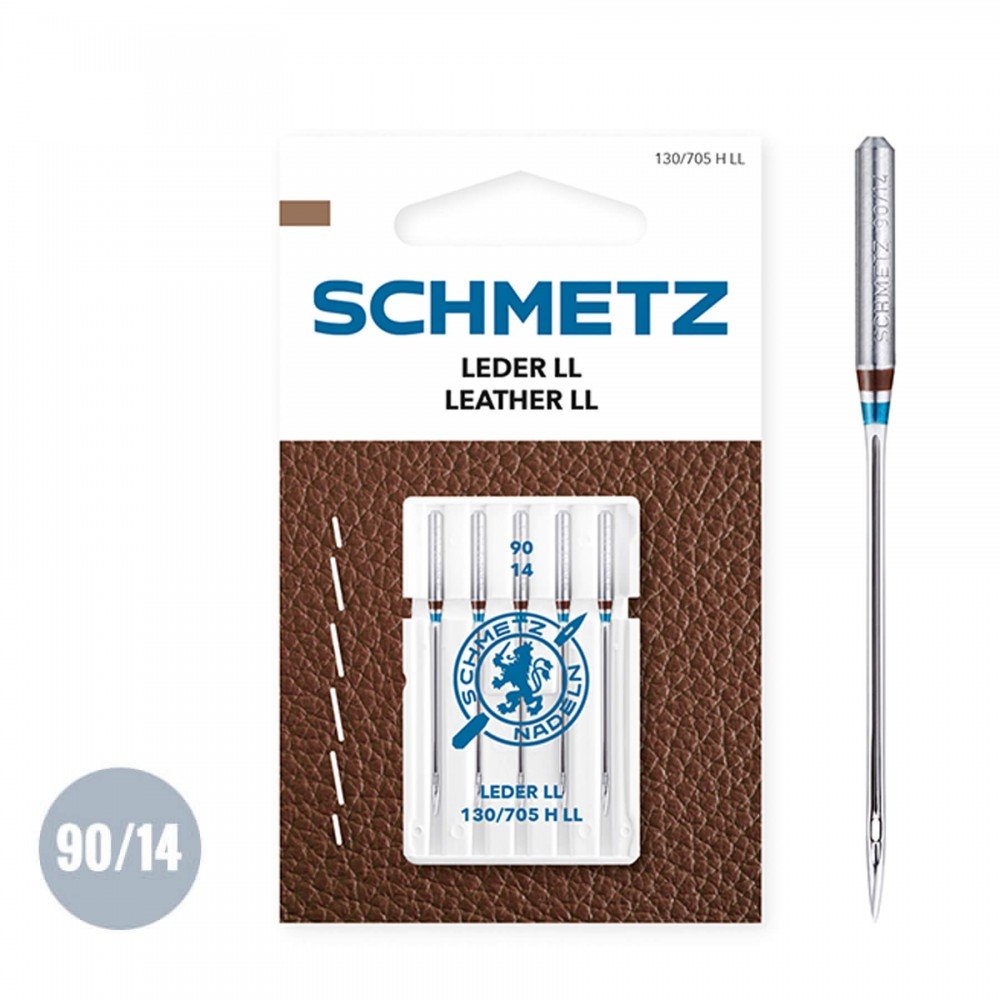
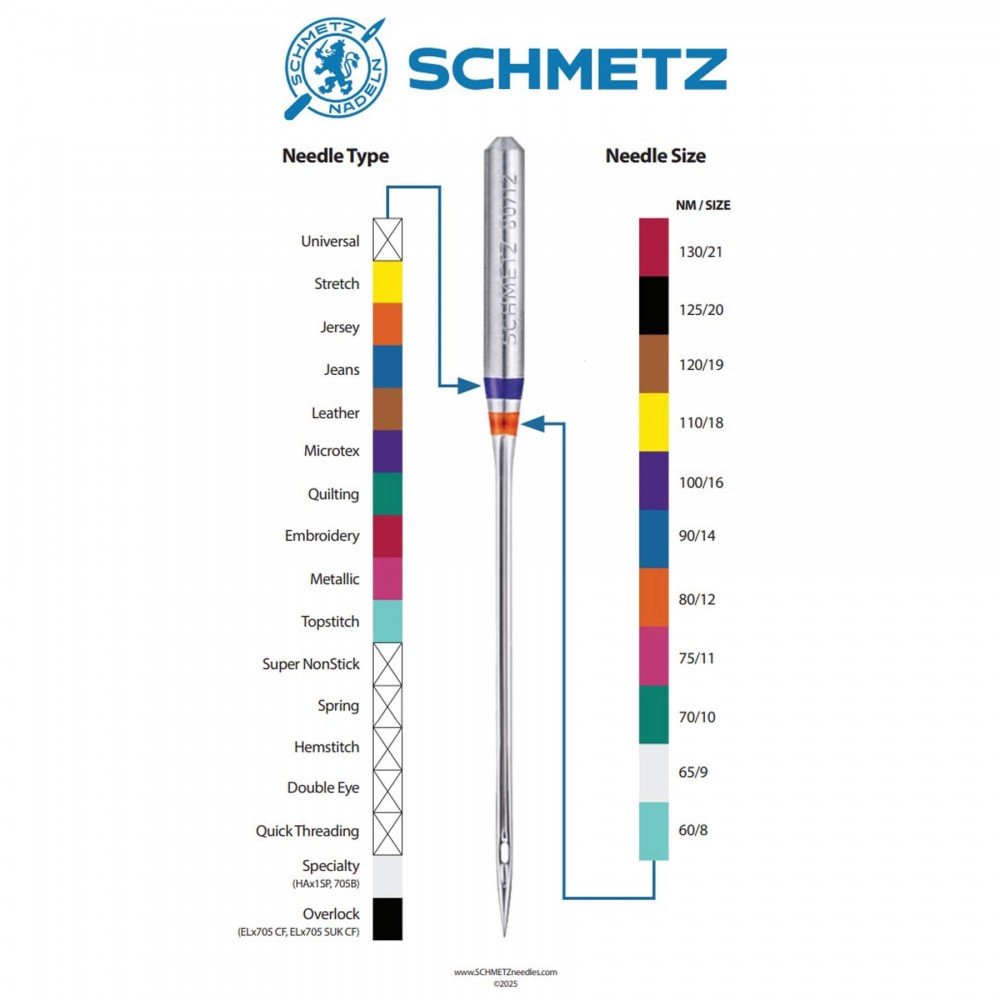
- Needle: a leather needle 90/14 or 100/16, such as the Schmetz leather needles 90/14 (€3.50 incl. VAT for a pack of five). You'll find more sizes under needles.
- Stitch: a straight stitch of 3 to 3.5 mm. With short stitches the holes end up so close together that the cork can tear, like the perforated edge of a stamp.
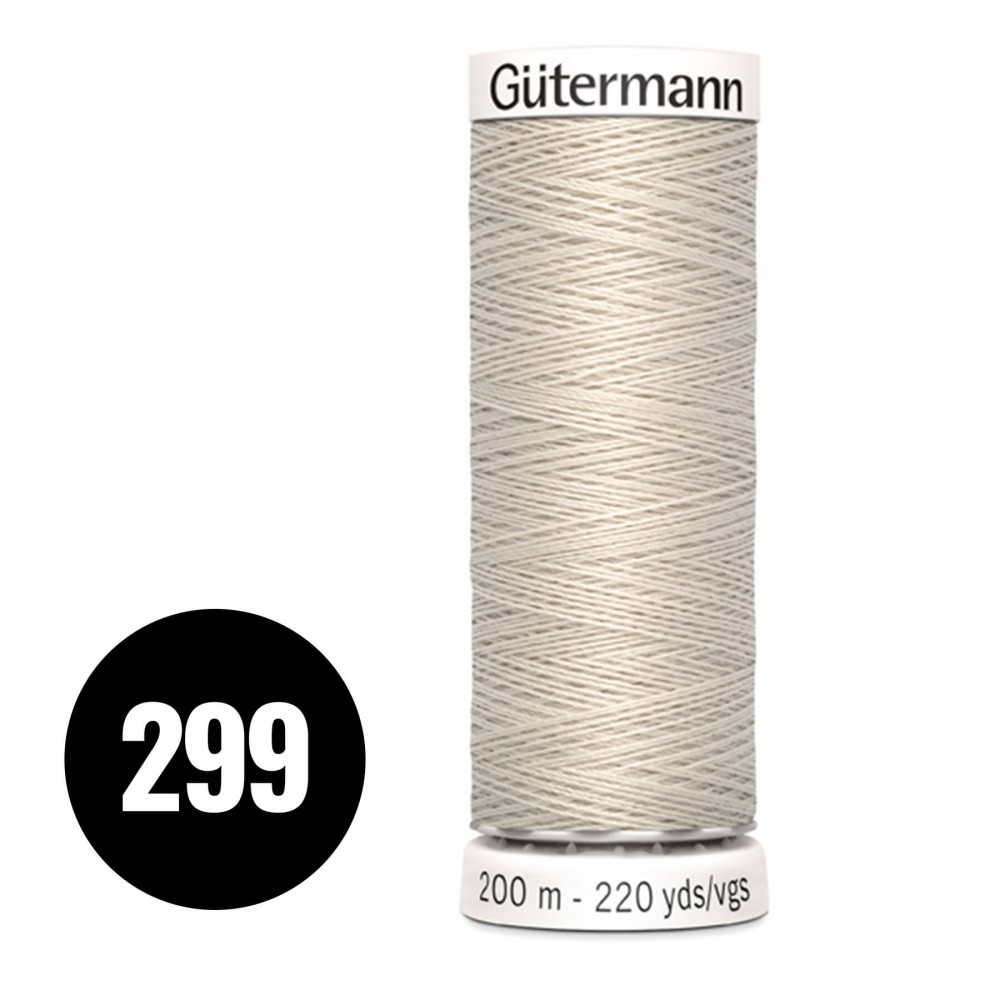
- Thread: strong polyester thread, such as Gütermann Sew-All. The colour natural beige (€3.95 incl. VAT) blends into the cork; a dark brown thread, on the other hand, gives you a decorative seam.
- Marking: on the back, in pencil. On the cork side you'll never get the lines off again.
- No ironing. Rub seams flat with your thumbnail or the back of a spoon. If a piece has been rolled up, lay it flat under a few books overnight.
- Does the cork stick under the presser foot? Place a strip of baking paper between the foot and the cork and tear it away after stitching, or use a Teflon foot or walking foot.
Sew a test seam on a scrap first. You'll see straight away whether the stitch length and thread tension are right, without sacrificing a piece of your project.
Project 1: cork card holder (free pattern)
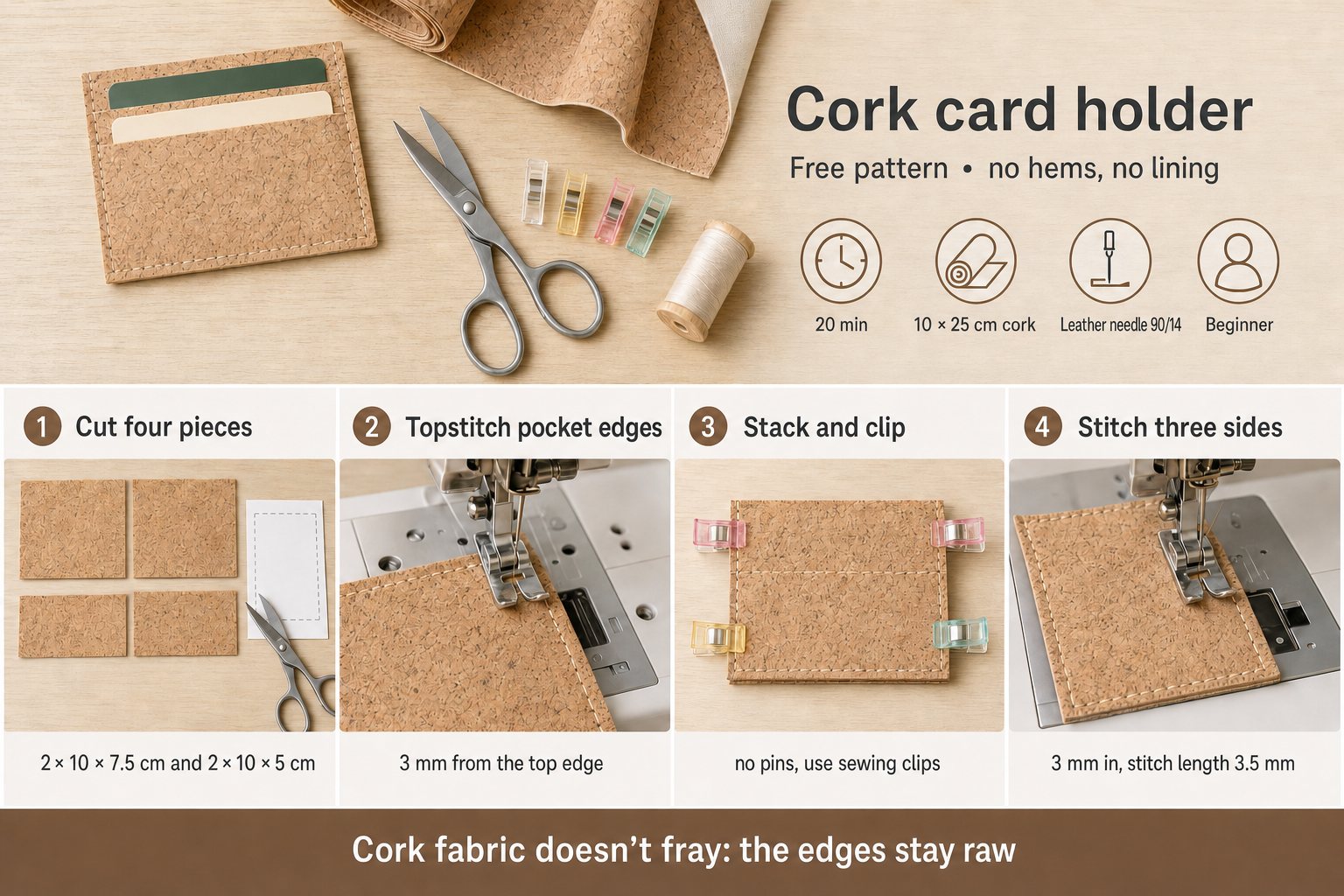
A flat card holder with three compartments: a slip pocket on the front, one on the back and a centre compartment for receipts or folded notes. It measures 10 × 7.5 cm and has no lining and no hems. You sew a single seam. It's finished in twenty minutes.
What you need
- a strip of cork fabric measuring 10 × 25 cm
- leather needle 90/14, polyester thread, sharp scissors or a rotary cutter, four sewing clips
- the templates from the free pattern (page 2, at actual size)
How to sew the card holder
- Print the pattern at 100% and measure the test square: it must be exactly 3 × 3 cm. Cut out the two templates.
- Cut four pieces: two main pieces of 10 × 7.5 cm and two pocket pieces of 10 × 5 cm. Mark on the cotton back and cut cleanly; the cut edge stays on show.
- Topstitch the top edge of the two pocket pieces, 3 mm from the edge. It is mainly decorative, but it also strengthens the edge.
- Stack the pieces: place a pocket piece on each main piece, cork side up, with the bottom edges level. Lay the two sets back to back. Secure everything with sewing clips.
- Stitch down one side, along the bottom and up the other side in one go, 3 mm from the edge. At the corners, leave the needle down in the cork, lift the foot and pivot the work. Backstitch three stitches at the start and the end.
- Trim the edges if the layers aren't perfectly level. Done.
A bank card is 8.6 cm wide; there is 9.4 cm of space between the seams, so two or three cards fit in each pocket. The cards stick out half a centimetre above the pocket, which makes them easy to grab.
Download the free cork pattern (PDF)
Project 2: zip pouch
A flat pouch of roughly 20.5 × 11.5 cm, for pens, make-up or chargers. Because cork doesn't fray, there is no need to sandwich the zip between two layers: you simply lay the cork on top of the zip tape and stitch it down.
What you need
- two pieces of cork fabric measuring 22 × 12 cm
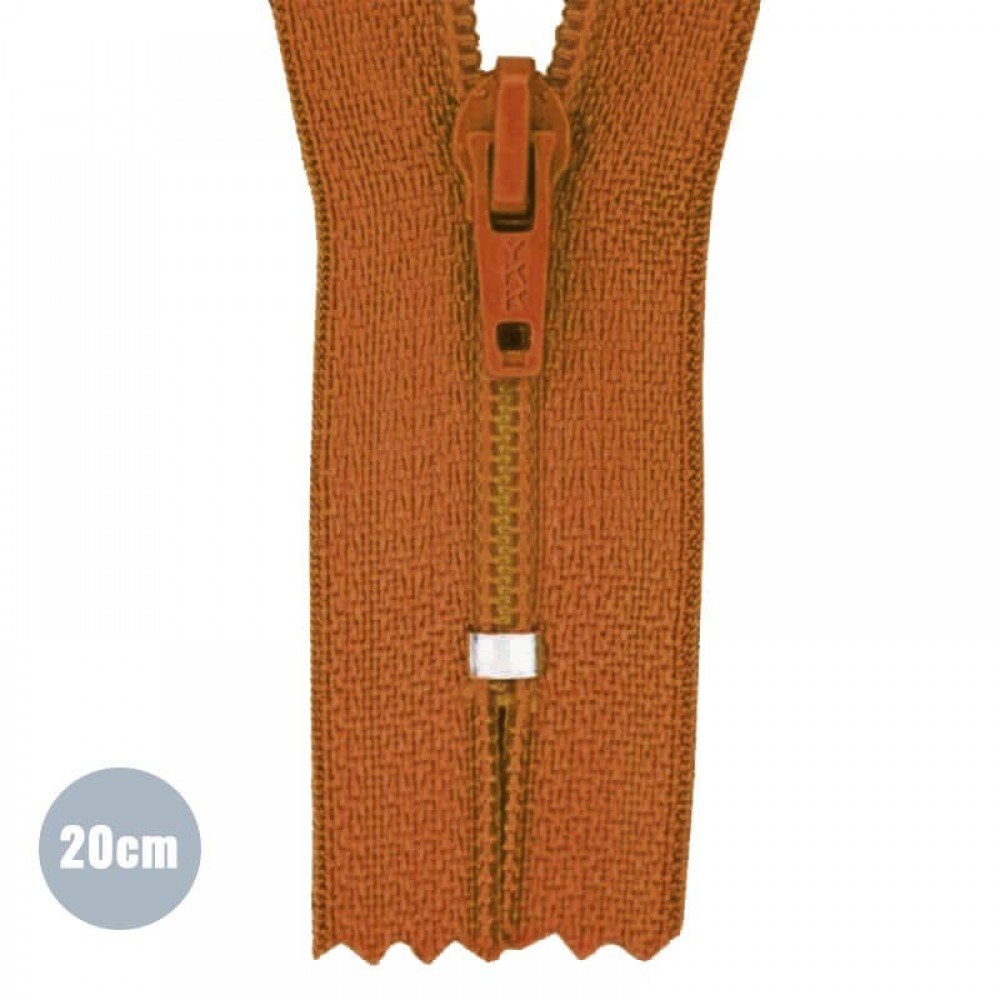
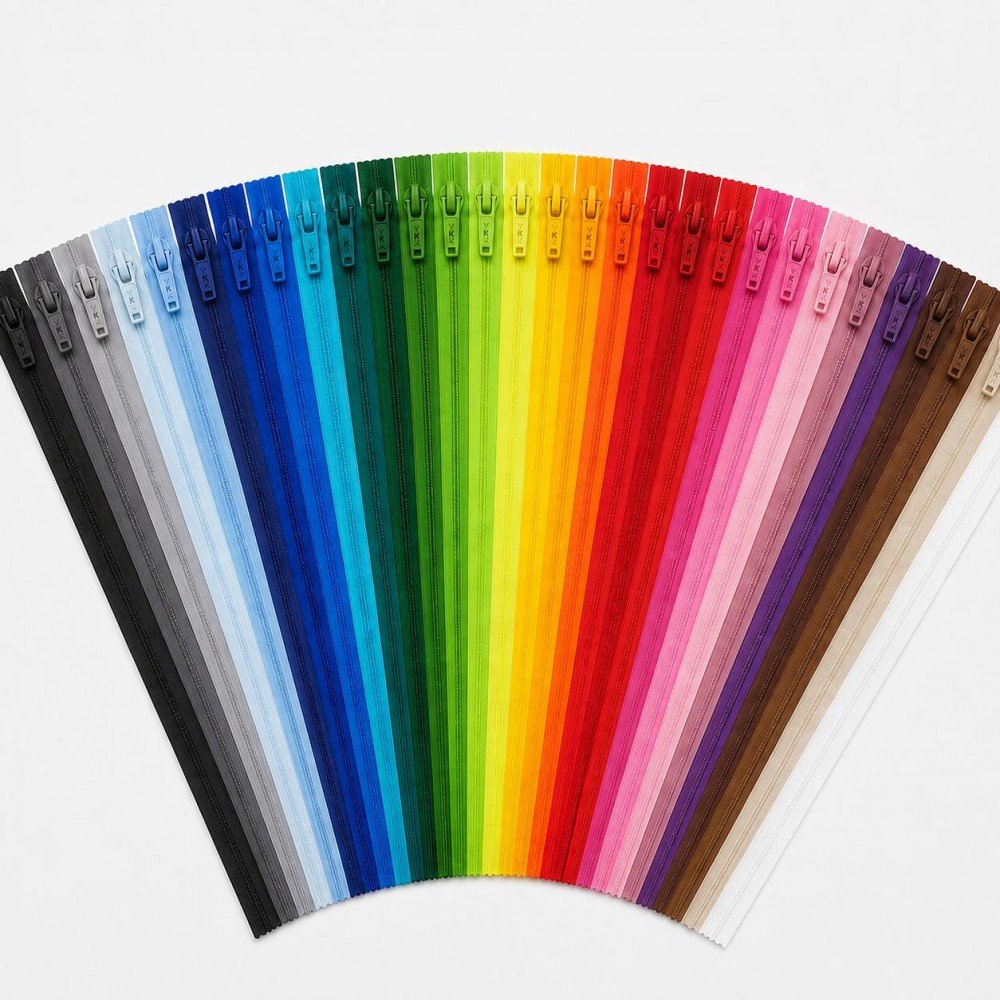
- a 20 cm closed-end zip, such as the YKK zip in cognac (€1.15 incl. VAT); you'll find all the colours under 20 cm zips
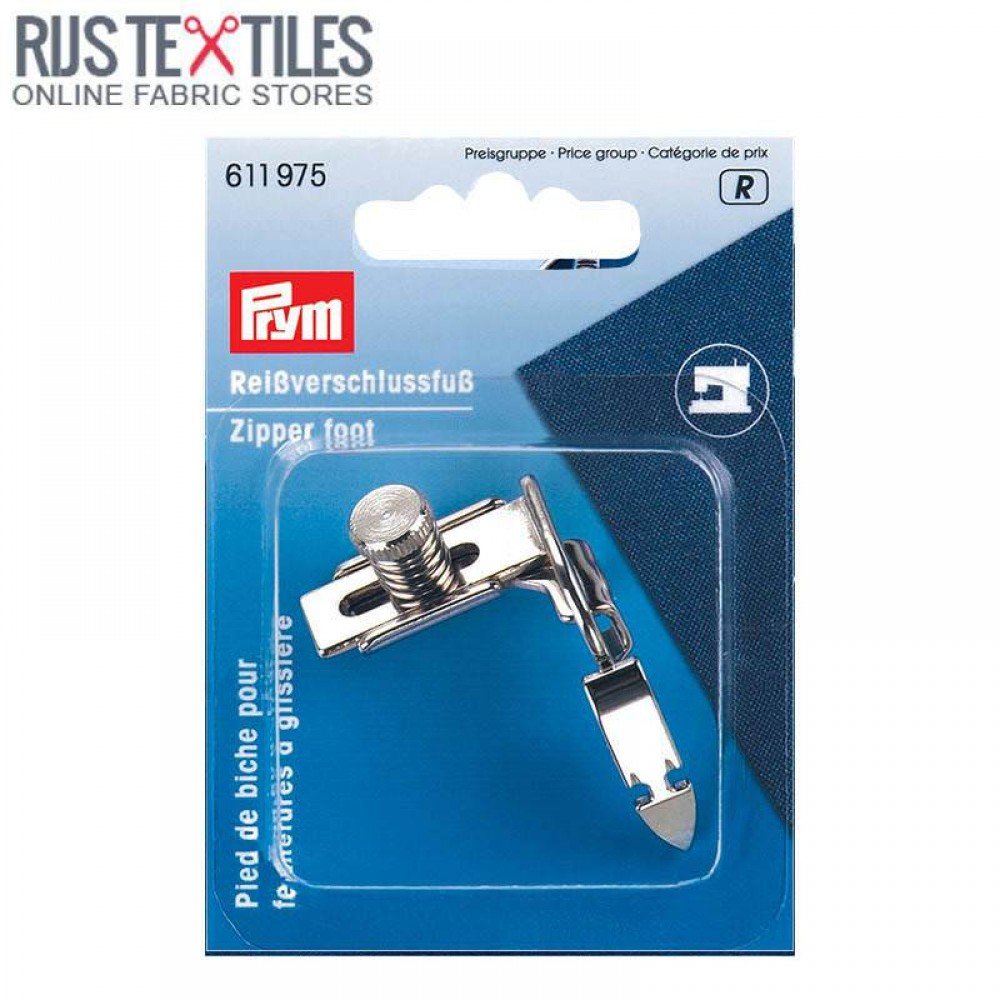
- leather needle, thread, sewing clips, and ideally a zip foot (€4.95 incl. VAT) if your machine doesn't have one
How to sew the pouch
- Lay the closed zip in front of you, right side up. Place the long edge of the first piece of cork on the zip tape, cork side up, 3 mm from the teeth. The zip sits centred on the 22 cm. Secure with sewing clips or tape.
- Stitch the cork to the zip tape, 3 mm from the cork edge, using the zip foot.
- Do the same with the second piece on the other side of the zip.
- Open the zip halfway. Don't skip this step, or you won't be able to turn the pouch later.
- Fold the pieces cork sides together and stitch the two sides and the bottom with a 0.75 cm seam. At the ends of the zip, turn the handwheel by hand so the needle passes over the zip gently.
- Clip the two bottom corners diagonally, just outside the seam. Turn the pouch through the zip and gently push out the corners with a blunt pencil.
Straight after turning, the cork will bulge a little. Rub the seams flat with your fingers and leave the pouch under a book overnight.
Project 3: coasters
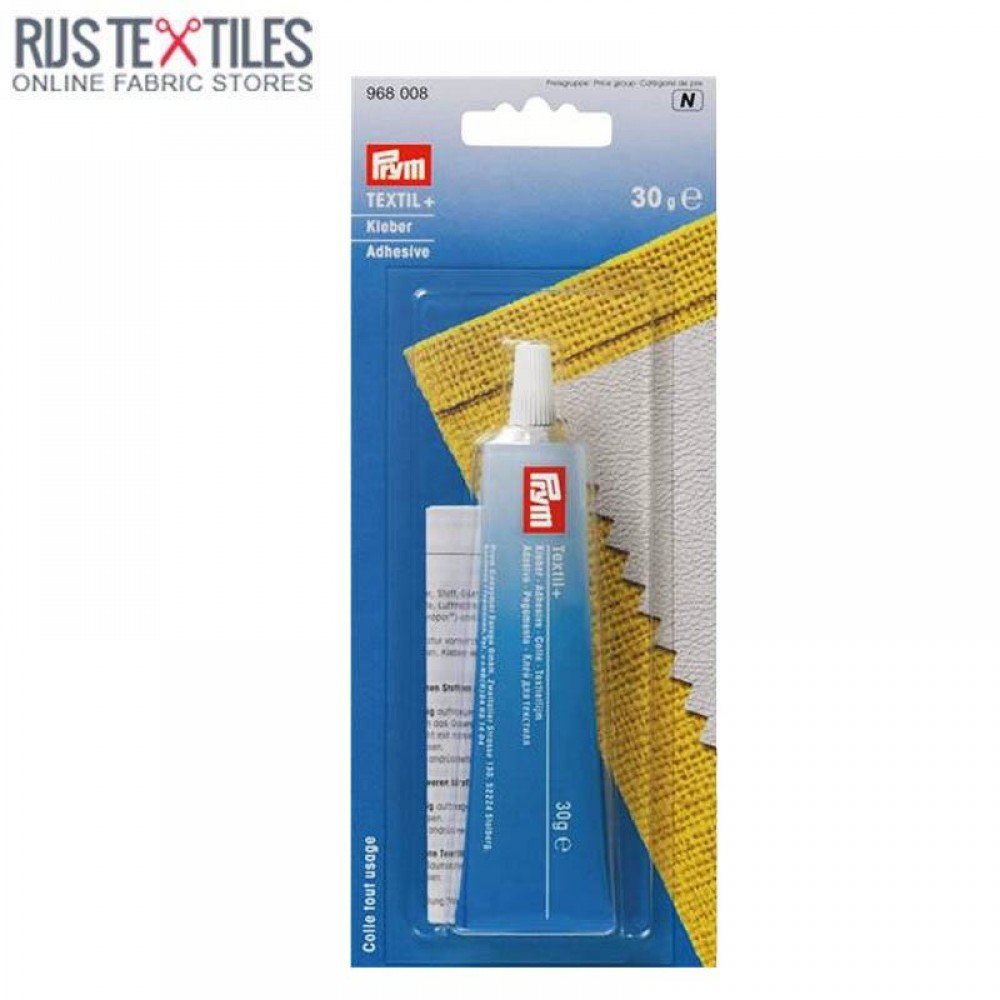
The quickest project, even without a sewing machine. Cut two circles 10 cm in diameter for each coaster; the template is in the pattern. Glue them together, cotton backs facing, with textile adhesive (€3.95 incl. VAT) and leave them to dry under a book overnight. Or stitch all the way round, 3 mm from the edge. With the double layer there is cork on both sides and the coaster won't warp. A set of four tied with a ribbon is a gift you can make in half an hour.
What does it cost?
| Project | Cork fabric | Cost (incl. VAT) |
|---|---|---|
| Card holder | 10 × 25 cm | about €0.55 of cork |
| Zip pouch | 2 × 22 × 12 cm | about €1.15 of cork + €1.15 for the zip |
| 4 coasters | 8 circles of 10 cm | about €1.75 of cork |
The amounts are worked out from the price of €29.95 per metre (incl. VAT) at the time of writing. From one metre of 140 cm wide cork fabric you can cut more than fifty card holders, or a whole pile of assorted Christmas presents. You'll find more sewing ideas in our blog on handmade Christmas gifts. If a cork bag is next on your list, first read the five mistakes when making a bag.
Frequently asked questions
What is cork fabric?
Cork fabric is a thin layer of real cork, the bark of the cork oak, laminated onto a cotton backing. It is as supple as leather, doesn't fray and can be sewn on an ordinary sewing machine. The cork fabric from Rijs Textiles is 80% cork and 20% cotton, 140 cm wide and 0.7 mm thick.
Can you sew cork on an ordinary sewing machine?
Yes. Use a leather needle 90/14 or 100/16, strong polyester thread and a straight stitch of 3 to 3.5 mm. Don't pin, because the holes stay visible; use sewing clips. A domestic machine can handle four layers of 0.7 mm cork fabric.
Can you wash cork fabric?
Not in the washing machine. Wipe stains away with a damp cloth; if it is really necessary, wash cork fabric gently by hand. Do not tumble dry, iron or bleach.
Does cork fabric fray?
No. You can leave the edges raw, with no hem or binding. Do cut cleanly with sharp scissors or a rotary cutter, though, because the cut edge stays on show.
What is cork fabric used for?
For bags, purses, card holders, pouches, coasters, placemats, labels, book covers and home décor. Cork fabric is less suitable for close-fitting clothing, because it doesn't stretch and can't go in the washing machine.
Leave a Comment