
How Much Fabric Do I Need? Real Calculations for Curtains, Hoodies, Tablecloths and More
How much fabric do I need is the question we get asked more than any other, and honestly, most people underestimate it. They measure the window, or the table, or their own waist, and forget that fabric doesn't behave like a tape measure. It has a repeat, a nap, a width that isn't always what you expect, and shrinkage after washing that nobody accounts for until the curtains come out three centimeters short. Ask five sewists how they calculate yardage and you'll get five different answers, and at least two of them will be wrong.
We've watched customers order too little and end up paying twice for shipping on a second order, and we've watched businesses order too much and sit on rolls of fleece fabrics they'll never use. Both are avoidable. Below are real calculation examples, the kind we actually run for customers, so you can do the same math for your own project before you place an order.
Why fabric math isn't just length times width
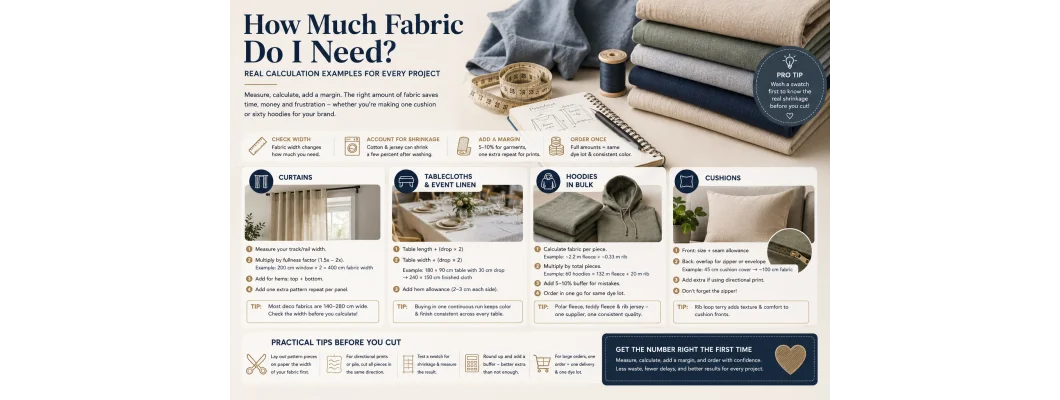
The basic idea is simple: you multiply how many pieces you need by how much fabric each piece takes, then add a margin for mistakes, shrinkage and pattern matching. But the details change everything. Fabric width matters more than most people realize. A 280cm wide deco fabric for curtains uses completely different math than a 150cm wide jersey. If you buy the wrong width, you either waste half the fabric on offcuts or need double the length to get the coverage you wanted.
Shrinkage is the other thing people forget. Cotton and jersey can shrink a few percent after the first wash, so if you're making garments that'll be washed regularly, like hoodies, add a small buffer to your length calculation rather than cutting exactly to the pattern. Stretch fabrics like rib knit jersey fabric behave differently again: you need less fabric because the stretch does some of the work, but you need to know the stretch percentage before you cut, or your cuffs end up too loose.
Calculating fabric per project type
Curtains
For curtains, start with the width of your track or rail, then multiply by a fullness factor. Most curtains look better with one and a half to two times the rail width in fabric, so a 200cm wide window with double fullness needs 400cm of fabric width, which you get by joining panels since most decor fabric comes in widths around 140 to 280cm. For length, measure floor to rail or sill to rail, then add extra for the top hem and header, plus extra for the bottom hem. If the fabric has a pattern repeat, add one extra repeat per panel so the pattern lines up when panels are joined. Check our deco fabrics range for the current widths before you calculate, since this changes how many panels you need to join.
Tablecloths and table linen for events
Tablecloths are one of the easier calculations once you know the drop you want. Take the table length, add twice the drop length you want hanging over the edge, then do the same for width. A rectangular table of 180 by 90cm with a 30cm drop on each side needs a finished cloth of 240 by 150cm, plus hem allowance of a few centimeters per side. Where this gets interesting is bulk orders, the kind we help event companies with regularly. If you're outfitting a hall with twelve round tables instead of one, the math multiplies fast, and buying from our fabric range in one continuous run keeps the color and finish consistent across every cloth, which matters a lot when they're all sitting in the same room under the same lighting. Our linen fabrics are a common pick for this kind of order because they hold their shape well over long tables and don't cling.
Hoodies in bulk
Hoodies are where fabric math really pays off or really bites you. One customer, Owen, ran the numbers for a batch of 60 hoodies and landed on 135 meters of fleece plus 20 meters of rib. That works out because a hoodie body and hood typically use a bit over two meters of fleece per piece once you account for pattern layout and a bit of waste between pieces, while the ribbing for cuffs and waistband needs far less fabric per garment since it's cut in narrow strips. This is exactly why we stock polar fleece fabric and teddy fleece fabric alongside ottoman rib jersey fabric, so a bulk order like this comes from one supplier instead of three. If you want a softer, plush finish instead of classic fleece, minky fleece fabric or the striped version, minky fleece stripes, changes the drape slightly, so recalculate your per-piece meterage if you switch between them, since pile height affects how the pattern pieces lay out.
Cushions
Cushions are the smallest calculation but people still get them wrong, usually by forgetting the back panel needs an overlap for a zipper opening or an envelope closure. For a standard square cushion, you need two front-sized pieces plus a bit extra on one for the overlap, or one front piece and two smaller back pieces if you're doing an envelope back. A 45cm cushion cover needs roughly 100cm of fabric length if you're cutting front and back from the same width, less if the fabric is wide enough to fit both across. If you're adding a zipper closure, pick it up along with your fabric so you're not waiting on a separate delivery, our zippers ykk range covers most cushion sizes. For texture, rib loop terry fabric gives cushions a nice tactile front panel without adding bulk.
Practical tips before you cut
- Always wash and dry a swatch first if the final piece will be washed, so you can measure actual shrinkage rather than guessing.
- Lay your pattern pieces out on paper the width of your fabric before ordering, it catches layout problems on paper instead of on your cutting table.
- For anything with a directional print or pile, like vegan leather fabric or fleece, cut all pieces in the same direction, which uses more fabric than a mixed layout but avoids visible color shifts under light.
- Order five to ten percent more than your calculation for garments, and a full extra pattern repeat for curtains, rather than cutting it razor thin.
- For bulk orders, order the full amount in one go rather than two smaller orders. Dye lots can vary slightly between batches, and nothing is worse than forty tablecloths that don't quite match.
Choosing the right approach for your project
Small one-off projects, a cushion or a single hoodie, are forgiving. Round up, buy a bit extra, and you're fine. Bulk projects are not forgiving in the same way. If you're making dozens of anything, run the calculation properly before you order: total pieces times fabric per piece, plus your buffer, then check that against the fabric width you're actually buying, not the width you assume. Browse our new fabrics or the fabric outlet if budget is tight on a large order, since outlet rolls are often full bolts, which is exactly what you want for consistent bulk cutting.
Get the number right the first time
Fabric math isn't complicated once you break it into pieces per project, fabric per piece, and a sensible buffer. Where people go wrong is skipping the swatch test or assuming a width that isn't accurate. Whether it's forty meters of table linen for an event or Owen's 135 meters of fleece for a run of hoodies, the same logic applies: measure, calculate, add a margin, then order once. Check our jersey fabrics range for current widths before you run your final numbers, since width is the variable that changes your total the most.
FAQ
How much extra fabric should I add for mistakes?
Five to ten percent on top of your calculated amount is a safe margin for garments. For curtains and tablecloths, round up to the nearest full pattern repeat instead, since a partial repeat is harder to work with than a few extra centimeters.
Does fabric width really change how much I need to order?
Yes, significantly. A wider fabric can mean fewer joins and less total length needed, while a narrower fabric might mean you need double the length just to get the coverage across a table or window. Always check the actual width listed on the product page before calculating.
Should I wash my fabric before cutting?
For anything that will be washed regularly once finished, like hoodies or cushion covers, yes. Wash and dry a test swatch first so you know the real shrinkage percentage, then add that back into your length calculation.
Is it cheaper to order fabric for a bulk project all at once?
Usually yes, and it avoids color or batch differences between separate orders. For large runs like Owen's 60 hoodies, ordering the full amount in one go also means one delivery and one dye lot across the whole run.